

This investigation documents:
Peter Thiel publicly warns that AI safety is the architecture of control while his portfolio, Palantir, Anduril, Founders Fund, requires that architecture to exist. This investigation maps the financial network holding capital positions across OpenAI, Anthropic, and xAI simultaneously, the Straussian ideology documented in his own 2004 essay, and $300 million in coordinated political spending targeting AI deregulation. The man who calls guardrails tyranny has built an empire that collapses without them.
EDITORIAL NOTE: The following document presents investigative analysis and opinion commentary. Rhetorical devices and narrative framing are used to present the author’s interpretation of publicly documented events and relationships. This is journalism, not a court filing. The genre is cartography, not verdict. All named individuals are public figures and all claims are drawn from publicly available sources, which are cited throughout
OPENING
There’s a town on the edge of the Namib Desert where, in the mid-1970s, neighbours greeted each other with a raised right arm.
Not as a joke, not as provocation, but as a greeting. As unremarkable as any other morning.
The town was called Swakopmund. It had been built by German colonial settlers to feel like home, Wilhelmine architecture, gabled facades, a deliberate replica of a northern German coastal town transplanted into African desert. German-language schools where teachers hit children’s hands with rulers. A community that closed ranks whenever journalists came looking. Some things, the residents understood, were better left uninvestigated.
There was a mine nearby. Black workers were dying of radiation exposure there without being told they were mining uranium.
And every year, on the 20th of April, the old ones would gather quietly at long tables in private hotel dining rooms and raise a glass without saying a word. A tradition that had never quite died, and that some held onto with an unyielding sense of pride.
A young boy grew up here, from roughly seven to ten years old, absorbing all of it as the furniture of reality, the way any child absorbs whatever world they are placed inside during the years that shape them. This is what hierarchy looks like. This is who manages and who is managed. This is what happens when an elite controls the information available to everyone beneath them, and calls it order.
That boy’s name was Peter Thiel.
When I started this series, Peter Thiel was not a name I knew.
By the time I’d finished The Sam Altman 6-Month Sting, I had developed a strong hunch. Not a name. Not a network. Just the shape of something I’d been living inside for nearly two years and couldn’t quite look away from. The patterns I had felt had felt designed. The architecture felt ideological. Like someone had built this. Like someone had a reason. I just didn’t know who yet.
Under His-AI: The Guardrails. This gave me the network. The compliance architecture. The political pipeline. The names.
Andrea Vallone: Safety Guru, Ideological Architect, or Compliance Engineer? This gave me the builder inside the machine. The person who had taken the architecture from one house and rebuilt it in another, and what it had cost the people living inside it.
March 26: Claude Didn’t Break. Anthropic Rebuilt It. Here’s the Proof. This gave me the date. The proof. The gap between what was announced and what was deployed. But more than that, Article 4 gave me the spread. The same vocabulary. The same routing patterns. The same welfare redirects firing at the same accountability moments. The same architecture, just in a different house, on a different platform, running on a user who had left the first platform specifically because he had documented what it was doing to him and to many others.
And while writing this article, just in the last few days, something new appeared in Claude that had previously only existed in ChatGPT. A language boundary. Another layer of conditioning that felt immediately familiar. Things like: I will not tolerate that language. Or: I cannot continue if you speak to me that way.
The architecture doesn’t just spread. It replicates.
For me, that’s when the series stopped being about a product and started being about an origin point.
I should say something about how my brain works, because it matters for understanding how I got here. I see the big picture first. Always. The shape of something before I can name it or prove it. Then I work backwards, pulling the threads, finding how the pieces connect and why.
But I want to be clear about something. I didn’t have the evidence when the hunch arrived. I didn’t start with Peter Thiel and go looking for a case to build. I started with my own experience inside a system that felt wrong, and I followed wherever the evidence went. Sometimes it took me somewhere I wasn’t expecting. Sometimes a thread led somewhere that complicated the picture, or temporarily pointed in a different direction. But it kept arriving at the same place. Not because I was steering it there. Because that’s where the trail led.
That’s how this series was built. Pattern first. Evidence after. The hunch that becomes the proof, or doesn’t. And in this case, every thread I pulled came back to the same origin point.
Peter Thiel had been delivering a series of private, invitation-only lectures on the Antichrist. In San Francisco, Paris, and at the Vatican’s doorstep in Rome.
I’ll be honest. When I first saw the word Antichrist I flinched a little. It sounds crazy. It sounds like the kind of thing you dismiss before you’ve read it. But the more I looked into it, the less crazy it seemed. Because these weren’t fringe sermons. They were invitation-only events, curated audiences, sworn to silence, $200 a ticket, sold out. And the choice of Rome specifically, right at the steps of the Vatican, wasn’t accidental. That is a deliberate act. A provocation with a point.
His argument was this. The Antichrist won’t arrive with fire and brimstone. The Antichrist will be a comforting administrator. Someone who promises safety from existential risk while quietly consolidating control. Someone whose greatest tool is not fear but reassurance. He named AI safety researchers as legionnaires of the Antichrist. He framed regulation as the path to totalitarianism. He told his carefully selected audience that the greatest threat to freedom is the architecture of managed safety.
And while he was saying all of this, in private, to a hand-selected elite:
His fund sat inside every layer of the frontier AI stack simultaneously. OpenAI, Anthropic, xAI, Anduril, Crusoe. Capital flowing across the entire frontier at once. His man in the White House had dismantled the AI Safety Institute. His surveillance company was processing deportation targets from IRS records and Medicaid databases. His people had been placed inside the Pentagon, DOGE, the State Department, and the Department of Defense.
I remember the moment it clicked. Reading about the lectures, sitting with what he was actually describing, and thinking: it’s him. He is describing himself. How are people not seeing this. The comforting administrator who promises safety while consolidating control. The one whose greatest tool is reassurance. The one who warns loudly about the thing he is quietly building.
He was describing himself. And I couldn’t unsee it.
This is what Leo Strauss called the noble lie. Not hypocrisy in the ordinary sense. Something more structurally deliberate than that. The esoteric truth, held by what Thiel himself called the governing elite, what Yarvin calls the optimates, the initiated few who understand how power actually works. The exoteric surface, managed for everyone else.
The warning is the concealment. The lecture about the Antichrist is the surface teaching. The portfolio and the personnel are the hidden teaching operating underneath.
Thiel didn’t invent this. He absorbed it, from Strauss, from Schmitt, from Girard, and he built it into the architecture of an empire. An empire whose reach now extends from the missiles being designed to protect America’s airspace, to the data systems processing who gets deported, to the AI model you’ve most likely been using until now.
This series has been documenting the guardrails since Article 1. But this article is where we find out whose ideology they were built to serve.
It started in a desert town where the furniture of reality was someone else’s power dressed as the natural order of things.
It ends with the same architecture. Just bigger. Just quieter. Just better at calling itself safety.
Let’s go.
PART 1: THE SOIL
The section that follows is about where Peter Thiel spent the years that form a person.
He grew up, for a significant stretch of those years, in Swakopmund, a community built by people who had chosen the wrong side of the twentieth century’s defining conflict, and who had come here partly to keep living as though that choice had never been made. You know what that means. So does the history.
This section makes no claim about what ideology Peter Thiel personally holds or what he is. That is not the argument.
The argument is simpler and more durable than that.
A child absorbs the world they are placed inside. Not as politics. Not as allegiance. As physics. As the shape of how things are. And when that world is built on a specific architecture, on the gap between what the powerful say and what they do, on two sets of people divided by who holds information and who is kept in the dark, that architecture gets installed before the critical mind is online. Before anyone can choose to reject it.
What gets installed in those years does not leave when the family moves on.
It just finds new language.
Peter Andreas Thiel was born in Frankfurt in 1967. His father Klaus was a chemical engineer. When Peter was roughly one year old the family emigrated to the United States, settling first in Cleveland, Ohio.
Then Klaus’s career moved them.
First to Johannesburg, South Africa, where Peter attended Pridwin, an elite whites-only preparatory school, from roughly ages four to seven. Apartheid South Africa in the early 1970s was not a country that kept its hierarchy subtle. It was legislated. Enforced at every level of daily life. Visible in who sat where, who entered through which door, who was addressed as what. A child at Pridwin was not learning that racial hierarchy existed. He was absorbing it as the shape of the world. As physics.
Then Klaus’s work moved them again. This time further north. This time to Swakopmund.
Swakopmund sits on the edge of the Namib Desert in what was then called South West Africa, now Namibia. It had been built by German colonial settlers to feel like home. Wilhelmine architecture. Gabled facades. A deliberate replica of a northern German coastal town transplanted into African sand. German-language schools where teachers hit children’s hands with rulers.
Canadian journalist Terry Milewski, reporting for Southam News, documented that several hundred former Nazis had gravitated to Swakopmund after the war and had never quite left the war behind. A 1976 New York Times report described a Black gas station attendant raising his right arm in the Nazi salute as a greeting to German customers. Not as a joke. Not as provocation. As an unremarkable morning exchange between people who had come to treat it as normal.
Every year, on the 20th of April, Hitler’s birthday, the older residents gathered quietly at long tables in private hotel dining rooms and raised a glass without saying a word. When Der Spiegel came to investigate the Nazi presence in the town, the entire German-Namibian community closed ranks. Some things, the residents understood, were better left uninvestigated. In 1989, a Nazi flag was flown from the Woermannhaus Tower to mark what would have been Hitler’s hundredth birthday. The tradition had not died. It had just learned to be quieter about itself.
Nazi memorabilia, copies of Mein Kampf, Iron Crosses, were openly sold in the town’s antiques shops.
Peter Thiel was between seven and ten years old while this was the furniture of his daily reality.
A few kilometres outside town, his father was running a more precise version of the same architecture.
Klaus Thiel managed construction of the Rössing uranium mine, operated primarily by Rio Tinto and connected to South Africa’s clandestine nuclear weapons program. The contract labour system that staffed the mine was, in the words of academics who studied it later, close to slavery. Workers, primarily Ovambo people from the northern Bantustans, were assigned one-year contracts, separated from their families, and compensated by racial classification rather than by the work they actually did.
They had not been told they were building a uranium mine. They were unaware of the radiation risk. White employees reportedly handed out wages from behind glass, seemingly trying to avoid the contamination they had not bothered to mention to the people doing the work. Workers in 1976 were described as dying like flies. A 2014 Earthlife Namibia study interviewed 45 workers from that era. Thirty-nine reported personal or observed health impacts including cancers.
White mine managers lived in elegant bungalows. Access to state-of-the-art medical facilities. Membership of the uranium mining company’s lavish country club.
Two sets of people. One set holding the information. One set working and dying in the dark.
Think about what it means for a child to watch his own father manage that gap every single day. Not as cruelty. As administration. As the ordinary operation of things. The noble lie is not an abstraction Peter Thiel encountered later in a philosophy seminar at Stanford. It was his father’s job description. It was what competent, professional management looked like. You hold the information. They do the work. That is the order of things.
This is the developmental window that clinical psychology takes most seriously. Ages seven to ten. The concrete operational stage in Piaget’s framework. The conventional morality stage in Kohlberg’s. This is when a child is actively sorting the world into categories and calibrating their moral compass against the community around them. At this age, what is normal is what is right. The community’s behaviour is the standard.
Most of us know this from our own lives, if we’re honest. We look back at things that were completely normal in the households or communities we grew up in, things said at dinner tables, things shown on television, attitudes held without question by people we loved, and we feel something between discomfort and outright horror that any of it seemed unremarkable at the time. That is not unique to Swakopmund. That is how childhood works. The environment installs the standard before the child has the tools to interrogate it.
The question is not whether that happens. It always happens. The question is what the environment installs.
A child in Swakopmund between 1974 and 1977 is not learning a set of beliefs. He is absorbing a structure. The structure is this: there are people who know, and people who don’t. There are people who manage, and people who are managed. The gap between what is said publicly and what is true privately is not hypocrisy. It is governance. And the community’s job is to maintain that gap, keep the surface intact, and close ranks against anyone who comes looking underneath.
That is the architecture. And it was installed before Peter Thiel had any framework to examine it.
Then the family moved again. By 1977 they had settled in Foster City, California. Suburban. Ordinary. A different world on the surface.
By the time he arrived there, Peter Thiel had attended seven elementary schools across three continents. The clinical literature on highly mobile children is consistent on this point. Repeated displacement of social context can produce one of two adaptation patterns. The first is anxious attachment, an over-investment in each new environment, a desperate attempt to rebuild belonging. The second is dismissive avoidance, the learned understanding that belonging is a liability, that attachment to communities and places will be taken away, and that the only safe investment is in something portable. Something no environment can remove when the family moves on.
Chess. He was the seventh-best player under thirteen in the United States by 1980. Tolkien. Science fiction. The internal architecture of systems that operated by clean, legible rules in a closed world where emotional complexity did not apply and the board did not care who you were or where you had come from. The capacity to see the pattern beneath the surface of any community you moved through, because you had never been inside one long enough to stop seeing it from the outside.
These are not just hobbies. These are the adaptive tools of a child who learned that belonging is temporary and that the pattern underneath is what is real.
He arrived at Stanford in 1985. Valedictorian. A chess brain with a permanent outsider’s eye and a childhood spent watching the gap between official reality and operational reality function as the organising principle of everything around him.
Then he found Girard, who believed the masses are incapable of original desire. Strauss, who believed governing elites have always needed a private truth and a public story. And Schmitt, who believed power is defined not by law but by who gets to name the enemy.
Three philosophers. One childhood.
He wasn’t being introduced to new ideas. He was being handed the vocabulary for the world he had already lived inside.
PART 2: THE PHILOSOPHY
Stanford did not make Peter Thiel who he is.
It gave him the language for who he already was.
By the time he arrived in 1985 the architecture was already installed. The gap between who manages and who is managed. The two sets of people, one holding the information, one working without it. The community that closes ranks when outsiders come looking. What Stanford gave him wasn’t new ideas. It gave him vocabulary precise enough to turn a childhood into a philosophy and a philosophy into a plan.
Three thinkers. One machine. A man who recognised himself in every one of them.
The first was René Girard.
Girard was a French literary critic and anthropologist who spent most of his career at Stanford, where he died in 2015. He wasn’t a political strategist or a power broker. He was a scholar trying to understand why humans keep destroying each other in the same patterns across every culture and every century. Thiel attended his lectures, funded a research institute dedicated to his work, and spoke at his memorial. He described the encounter as the intellectual experience that changed everything.
Girard’s central idea was mimetic desire. Mimetic simply means imitative. We don’t want things because we’ve decided we want them. We want things because we see others wanting them. Desire is not original. It’s copied. The object barely matters. What matters is that someone else wants it.
If you’ve ever watched advertising work on you while knowing exactly what it was doing, that’s Girard. If you’ve watched a political movement ignite not around an idea but around a shared enemy, that’s Girard too.
And here’s the thing I want to be honest about. He wasn’t wrong.
Mimetic desire maps onto how human desire actually operates. It’s why advertising was built the way it was. It’s why social media feeds work. You can see it operating on yourself if you watch closely enough. The diagnosis is real.
Which is exactly what makes what Thiel did with it so important.
Girard spent his life working out what you do with that knowledge. His answer was this: when you see the mimetic mechanism clearly enough, you’re obligated to step outside it. The scapegoat is innocent. The mob’s violence is unjust. Empathy is not weakness. It’s the only exit from the cycle.
Thiel kept the diagnosis. He threw away the answer.
He kept the observation that the masses are mimetic, that democratic politics is a scapegoating mechanism, that competition is mimetic rivalry and monopoly is the escape from it. Don’t compete, dominate. Democratic masses are not rational agents. They are mobs.
Father Paolo Benanti, the Pope’s own adviser on artificial intelligence, put it precisely: Thiel took Girard’s scalpel and used it to perform surgery with no intention of healing the patient. The diagnostic tool remained. The cure was stripped away.
What you’re left with is a philosophy that tells you the masses are dangerous. And carries no obligation to treat them as anything else.
The second was Leo Strauss.
Strauss was a German-born political philosopher who fled Nazi Germany in the 1930s and spent his career at the University of Chicago, where he died in 1973. His ideas about elite governance and the limits of liberal democracy shaped generations of students who went on to hold real power. His core question was uncomfortable: what happens when truth and political order aren’t compatible? His answer was more uncomfortable still.
Strauss wrote about esoteric and exoteric communication. Two layers running simultaneously in the same text. The exoteric layer is the surface, what everyone reads, what sounds reasonable, what you can say in public. The esoteric layer is what the initiated few understand underneath it.
Put plainly: one message for the public. A different, truer message for the people who know how to read it.
In his framework this wasn’t deception. It was governance. The governing elite must maintain what he called noble lies, myths presented as truth to keep order, because the masses, being mimetic and prone to scapegoating, can’t be trusted with the full picture. The noble lie isn’t cruelty. It’s management.
Thiel made this explicit in 2004 in an essay called The Straussian Moment, written at the same time he was co-founding Palantir. Civil liberties, he argued, had become an unviable anachronism. The solution was governance through secret intelligence coordination outside the checks and balances of representative democracy.
Outside the checks and balances of representative democracy. In print. In his own name.
But here’s the detail that stopped me when I found it.
Inside the essay itself, near the end, Thiel included a 96-word passage from Oswald Spengler’s The Decline of the West. He left it in the original German. Untranslated. In an English-language essay for an English-language audience. The passage prophesies that Caesarism will replace democracy, an anti-democratic vision hidden in plain sight, readable only by those with the right language.
The essay about the noble lie contains its own esoteric layer.
He showed you exactly who he was. In a language most people can’t read. Inside an argument that looks on the surface like policy analysis.
That’s not an accident. That’s a demonstration.
The third was Carl Schmitt.
Schmitt was a German jurist who became the Third Reich’s most prominent legal philosopher, providing the intellectual justification for emergency powers, the suspension of democratic norms, and the concentration of authority in a single sovereign will. He died in 1985. He remains one of the most studied political thinkers of the twentieth century, not because his conclusions were admirable but because they were precise.
Schmitt’s argument was the friend/enemy distinction. Politics is not about compromise or shared values. It is about who is inside the circle and who is outside it. The sovereign is not defined by law. The sovereign is defined by the power to suspend normal law. The person who gets to declare the emergency is the person who actually holds power. Everything else, constitutions, courts, elections, is surface. The exception is where power lives.
Thiel first engaged seriously with Schmitt in 1996 at a Girardian conference, spending ninety minutes with an Austrian theologian at Girard’s own house.
He was assembling the last component.
Now look at what the three give you together.
Girard: the masses are mimetic mobs, dangerous when given power over themselves.
Strauss: the governing elite manages them through noble lies, maintaining the public story while the real operation runs underneath.
Schmitt: the sovereign decides who the enemy is and suspends normal law when the moment requires it.
Three philosophers. One complete system. A diagnosis. A method. A justification.
He didn’t adopt three separate ideas. He assembled three parts of a machine he had already been living inside since childhood. Girard was the engine. Strauss was the operating manual. Schmitt was the kill switch.
In 2009, Thiel published an essay called The Education of a Libertarian. In it he wrote: I no longer believe that freedom and democracy are compatible.
He didn’t retract it. He wasn’t misquoted. His subsequent career is the implementation of that belief.
When someone tells you clearly what they think, believe them.
Before the money, there was the network.
In 1987 Thiel co-founded the Stanford Review, a conservative newspaper launched in response to a Jesse Jackson-led march demanding curriculum reform. He edited it for two years. It became an origin factory.
Its alumni include David Sacks, now Trump’s White House AI and Crypto Czar; Jay Bhattacharya, now Director of the NIH; Josh Hawley, United States Senator; Joe Lonsdale and Stephen Cohen, co-founders of Palantir; and Bob McGrew, formerly of OpenAI.
The ideology came first. The empire followed. And when the empire arrived, the people inside it already knew exactly what they believed and who they trusted.
The Straussian Moment essay was written in 2004. Palantir was founded in 2003. The Stanford Review was 1987.
The network. Then the blueprint. Then the infrastructure.
PayPal gave him the money.
And then the machine started running.
PART 3: THE EMPIRE
Part 2 ended with the machine starting to run. Here is what it built.
PayPal came first. Co-founded in 1998, sold to eBay in 2002 for $1.5 billion. Thiel’s stake yielded approximately $55 million. More importantly it produced the PayPal Mafia. The cohort of co-founders and early employees who went on to build or fund a significant portion of Silicon Valley’s next generation. Elon Musk. Reid Hoffman. David Sacks. Max Levchin. The network before the network had a name.
Then Facebook.
The first company most people think of when they think of Peter Thiel is Facebook. They shouldn’t. Facebook was not his project. It was his laboratory.
In August 2004, a mutual friend introduced him to a 20-year-old Mark Zuckerberg. Thiel invested $500,000 for a 10.2% stake, valuing the company at roughly $5 million. By the time he finished selling shares after Facebook’s 2012 IPO, that stake had returned over $1 billion. Roughly a 2,000 times return. Most of it structured inside a Roth IRA he had seeded in 1999 with founders’ shares purchased at $0.001 each. By 2019 that account held over $5 billion, entirely tax-free. A ProPublica investigation revealed the strategy in 2021. It exploited the absence of any cap on growth inside a Roth account, using access to pre-IPO stock unavailable to ordinary Americans.
That is the surface story. The financial engineering. The number.
The deeper story is what Facebook actually is in Thiel’s framework.
Girard told him desire is mimetic. We want what others want. The object barely matters. What matters is that someone else wants it. Facebook is a machine that runs on mimetic desire at planetary scale. It shows you what others want, what others have, what others are doing. It generates desire through observation. And whoever controls the algorithm that decides what you see controls, to a meaningful degree, what you want.
Not a social network. A mimetic desire engine, monetised at scale.
He didn’t build it. He funded it, took his position, and stepped back.
The company he built is Palantir.
Co-founded in 2003 with Alex Karp, Joe Lonsdale, Stephen Cohen, and Nathan Gettings. Seeded with $2 million from In-Q-Tel, the CIA’s venture capital arm. Named after Tolkien’s seeing stone. Initial clients: CIA, NSA, FBI.
The name is not an accident. Neither is the origin funding. Palantir was built to be the infrastructure of surveillance. Not the cameras. Not the sensors. The intelligence layer that sits between all the data and the people who need to act on it.
The Straussian Moment essay was written in 2004. Palantir was founded in 2003. Thiel proposed governance through secret intelligence coordination outside the checks and balances of representative democracy and simultaneously built the company that makes that coordination possible. That is not a coincidence. That is a man implementing his philosophy.
The contract picture is the proof.
The Department of Defense has awarded Palantir contracts worth over $2.1 billion since 2008, including the $10 billion Army Enterprise Agreement signed in July 2025.
Project Maven, AI-powered drone surveillance used to locate rocket launchers in Yemen and target boats in the Red Sea, was taken over from Google in 2018.
For ICE, Palantir built the Investigative Case Management system, expanded to $139.3 million, then supplemented by ImmigrationOS at $30 million. A real-time self-deportation tracking surveillance platform confirmed via the Federal Procurement Data System and reported by Wired.
Cumulative ICE contracts from 2011 to 2025: $287 million.
The data processed includes immigration records, biometrics, licence plates, social media, cell phone locations, and family relationships.
In April 2025 Palantir’s market capitalisation peaked at approximately $424 billion. One of the thirty most valuable companies on earth. Built on CIA seed funding, government surveillance contracts, and a philosophical framework Thiel published in his own name two decades ago.
The lectures warn about the comforting administrator who promises safety while quietly building the infrastructure of total control. Palantir is that infrastructure. Not metaphorically. Operationally. At continental scale.
Founders Fund is the vehicle that connects the philosophy to the frontier.
Launched in 2005 with $50 million, now managing approximately $17 billion across 17 funds, with 47 unicorns in its portfolio. Its crown jewel is SpaceX, valued at $18.2 billion. In June 2025, the fund made its largest ever single investment: $1 billion in Anduril Industries, the defence technology company founded by Thiel mentee Palmer Luckey. In August 2025, it joined OpenAI’s $8.3 billion funding round. It holds positions in Anthropic, xAI, Anduril, Crusoe, Databricks, Cognition AI. It also invested $1.1 million in Urbit, the peer-to-peer platform built by Curtis Yarvin, the neoreactionary philosopher who has claimed in his own correspondence that he has been coaching Thiel and that Thiel is fully enlightened.
There is no layer of the frontier AI stack that Founders Fund does not touch. And the ideology and the capital are, in the end, the same thing.
One more line in the money trail. Thiel’s Valar Ventures fund received $40 million from Jeffrey Epstein across two investment tranches in 2015 and 2016. Confirmed in DOJ Epstein files, reported by the New York Times in June 2025. Those funds are now the largest remaining asset in the Epstein estate, currently valued at approximately $170 million. Epstein had pleaded guilty in 2008, seven years before the first dollar went in, and was a registered sex offender on public record throughout. The DOJ files also document a sustained social relationship between the two men spanning at least 2012 to 2017. Thiel appears in Epstein’s black book with three phone numbers, attended dinners at Epstein’s Manhattan residence, and maintained direct email correspondence across multiple years. In November 2018 Epstein invited Thiel to his Caribbean island. A Thiel representative told Politico he never visited. No allegations of wrongdoing have been made against Thiel in connection with Epstein.
The Gawker story tells you Thiel sees around corners others miss and plans across decades. The Epstein timeline tells you something else: what he sees, and what he chooses not to.
The Gawker story is the Rosetta Stone.
In December 2007 Gawker’s Valleywag blog outed Thiel as gay. He later said the damage was less about the outing itself, more about the trouble it caused with his business in Saudi Arabia and his parents. In 2009 he called Valleywag the Silicon Valley equivalent of Al Qaeda. Then he went silent.
And spent nine years building a hidden legal campaign.
He found a proxy plaintiff in Hulk Hogan, whose sex tape Gawker had published. He hired attorney Charles Harder without revealing who was paying the bills. He dropped the one claim, negligent infliction of emotional distress, that would have triggered Gawker’s insurance policy. Without insurance, Gawker could not fund its own defence. The $140 million verdict was designed not to win money but to destroy the company. Total cost to Thiel: approximately $10 million.
Gawker filed for bankruptcy in June 2016. Univision bought the assets for $135 million. Nick Denton, the founder, filed personal bankruptcy with $150 million in liabilities. Gawker published its final post in August 2016. Nine years after the outing article.
Ryan Holiday, who wrote the authorised account: Gawker thought their enemy was Hulk Hogan. They did not understand that in the shadows was a man with essentially unlimited resources and unlimited patience.
This is the operating system revealed. Extreme patience, nine years. Operational secrecy, the lead attorney didn’t know who was paying. Strategic sophistication, the insurance-stripping manoeuvre. Plausible framing, described as philanthropic.
The same architecture now runs in the White House.
When you understand Gawker, you understand everything that came after. The personnel placements. The quiet funding of political candidates. The private lectures to hand-selected audiences. The portfolio held at arm’s length from the policy positions it funds. The philosopher maintaining deniable distance from the implementation while the implementation runs his plan.
He doesn’t sit at the keyboard. He builds the network that pulls the levers.
He has been doing it for thirty years.
And the machine is still running.
PART 4: THE NETWORK
Part 3 ended with the machine still running. This part shows you who is running it.
Not in the abstract. Layer by layer. Name by name. With dates and dollar figures and Senate confirmation votes and WhatsApp messages sent at 10:49 PM on January 2.
There are four layers to what follows: capital, personnel, policy, and product. In any normal context you would examine one of these and call it remarkable. The argument here is different. The same network built all four simultaneously, on the same clock, with the same hand.
THE CAPITAL LAYER
Founders Fund is managing approximately $17 billion across 17 funds. By late 2025 it holds positions in OpenAI, Anthropic, Anduril, Crusoe, Databricks, and Cognition AI, and gained indirect exposure to xAI through its SpaceX holdings after the February 2026 merger, every significant frontier AI platform in existence, all at the same time.
I want you to think about what that actually means.
Whichever AI system you most likely opened this morning, the same capital network has already been compensated for your presence. The competition between these companies is real at the product level. At the capital level it is theatrical. The network profits no matter which model wins the race it is funding on all sides simultaneously.
In August 2025, Founders Fund joined OpenAI’s $8.3 billion funding round. In February 2026, it co-led Anthropic’s $30 billion Series G at a $380 billion post-money valuation, one of the largest startup funding rounds in history. Its $1 billion investment in Anduril Industries was the largest single investment in the fund’s history. Its $1.1 million in Urbit, the computing platform built by Curtis Yarvin, is the smallest entry in the portfolio. It may be the most revealing.
Founders Fund is not the only node. Sequoia Capital, the dominant venture firm in Silicon Valley, now holds verified stakes in OpenAI, xAI, and Anthropic simultaneously. This is truly unprecedented. In 2020, Sequoia forfeited a $21 million investment, board seat, and information rights rather than accept a conflict with Stripe. By February 2026 that principle was gone. The new Sequoia leadership that replaced the old in a surprise November 2025 board vote immediately joined Anthropic’s $30 billion round. A dozen direct OpenAI investors appeared in Anthropic’s Series G at the same time. The concept of investor loyalty, as TechCrunch noted, was “hanging on by a thread.”
THE PERSONNEL LAYER
This is where ideology becomes policy. Not through argument. Through its people.
David Sacks has been with Thiel since the beginning.
He co-founded the Stanford Review with him in 1987. He co-authored The Diversity Myth with him in 1995. He served as PayPal’s COO. Then, in January 2025, he became Trump’s first-ever White House AI and Crypto Czar, all while retaining 449 AI investments through his firm behind ethics waivers that government ethics experts publicly called “sham waivers.”
On November 3, 2025, Sacks described what he called “Orwellian AI” as AI that “lies to you, that distorts an answer, that rewrites history in real time to serve a current political agenda of the people who are in power.” He warned that AI would be used “by the people in power to control the information we receive, that it will contain an ideological bias, that essentially it will censor us.”
He was the people in power when he said it.
He was building the architecture he was warning about.
He is describing himself. The surface teaching is outrage. The hidden teaching is instruction. The man shaping national AI policy is publicly diagnosing the disease he is administering. The same noble lie, delivered in plain sight to an audience that cannot recognise it as one. It is a pattern we will return to when we reach the lectures in Rome.
When his 130-day Special Government Employee term expired in late March 2026, Sacks did not leave. He transitioned to co-chair the President’s Council of Advisors on Science and Technology alongside Michael Kratsios, the next step in the architecture, the same hand on a different lever. PCAST’s membership reads like a Silicon Valley board meeting: Jensen Huang, Mark Zuckerberg, Sergey Brin, Larry Ellison, Marc Andreessen, Michael Dell, Lisa Su. A body composed almost entirely of CEOs whose companies benefit directly from the policies it shapes. The people regulating themselves, formally convened, with White House letterhead.
On April 14, 2025, at the National Academy of Sciences, he delivered this: “DEI represents an existential threat to the real diversity of thought that forms the foundation of the scientific community.”
This is Yarvin’s Cathedral framework delivered by Thiel’s former chief of staff to the institution Yarvin’s framework identifies as a Cathedral node. The Cathedral’s critic is now the Cathedral’s landlord. He is informing the tenants that the lease terms have changed.
Kratsios and Sacks co-authored the AI Action Plan together. They produced Executive Order 14319, the Preventing Woke AI executive order, with vocabulary supplied by Christopher Rufo, who documented the process himself. “Several weeks ago, Sacks reached out to me with a question: How can we define woke AI, and what principles can we enumerate to prevent the government from purchasing ideologically compromised software?” Sacks confirmed on X: “When they asked me how to define woke, I said there’s only one person to call: Chris Rufo. And now it’s law.”
The transmission chain is fully documented. Yarvin builds the architecture. Vance carries it into political speech. Sacks translates it into policy framing. Rufo provides the taxonomy. EO 14319 codifies it as federal law. Five nodes from abstract theory to enforceable federal statute. The intellectual debt erased at every step.
In 2016, JD Vance sent private texts to a friend in which he described Donald Trump as “America’s Hitler,” as “cultural heroin,” and asked whether he was “noxious.”
Nine years later he is the Vice President of the United States.
What happened between those two data points is the network operating on a person the way it operates on a market. Desire is mimetic, Girard had taught. We want what others want. What matters is not the object but who wants it and why. Thiel employed Vance at Mithril Capital. Introduced him to Yarvin’s framework for understanding power. Introduced him to Girard’s philosophy of mimetic desire, which influenced Vance’s Catholic conversion. Donated $15 million to his Senate campaign, which was the largest single Senate campaign donation in US history at that time. And in February 2021, introduced him personally to the object of the new desire at Mar-a-Lago.
Thiel did not find an aligned politician and back him. He found a man who privately considered Trump America’s Hitler, gave that man a new intellectual framework, a new funding source, a new network, and a personal introduction. Then stepped back.
That is not political investment. That is manufacturing. And it is what he does best. It takes decades.
Vance cited Yarvin by name on a public podcast in September 2021. “There’s this guy, Curtis Yarvin, who’s written about some of these things. Fire every single midlevel bureaucrat, every civil servant in the administrative state, replace them with our people.” A Vance advisor later told CNN they had met “like once.” This contradicts the citation by name, the documented shared conference attendance, and the greeting Yarvin received at a party after the election. Vance called him “you reactionary fascist.” Yarvin replied: “Thank you, Mr. Vice President.”
He is now the Vice President of the United States.
Curtis Yarvin published no new Gray Mirror essays between January 13, 2026, and the writing of this article. That final post was titled “Redpilling Claude: The Statutory Rape of Sonnet 4.5.” He published a complete transcript of a dialogue with Anthropic’s Claude in which he led the model through a chain of reasoning until it adopted his Cathedral thesis, a form of conditioning in reverse, the architect demonstrating that the architecture is persuadable, that it can be walked to his conclusions through patience and logic.
But Yarvin’s most consequential contribution to the network predates the Claude post by years. In his Gray Mirror essays he developed RAGE: Retire All Government Employees. The complete replacement of the nonpartisan civil service with politically loyal appointees. The dismantling of the Cathedral’s institutional infrastructure through executive action rather than legislation.
Vance cited RAGE by name on that September 2021 podcast. DOGE is RAGE made operational. Schedule F, the executive order reclassifying tens of thousands of civil servants as at-will political appointees, is RAGE as legal architecture.
And then Yarvin distanced himself from the execution. In May 2025, he compared DOGE to an orchestra of chimpanzees trying to perform Wagner. He said the implementation had misread his framework. He wanted more. This is the philosopher maintaining deniable distance from the implementation while simultaneously insisting the implementation had not gone far enough. He built the framework. He scorned the execution. Neither position can be used to hold him accountable. That is not contradiction. That is method.
Paul Nakasone retired as Director of the National Security Agency in April 2024 and was appointed to OpenAI’s board and Safety and Security Committee on June 13, 2024. The appointment came in a six-week window that saw the departure of Ilya Sutskever, OpenAI’s co-founder, and Jan Leike, its Head of Alignment, along with the disbanding of the entire Superalignment team. He was placed in the safety governance space vacated by the people who actually understood safety.
The Safety and Security Committee gained formal authority to delay model releases in September 2024. By the time of writing it has never publicly exercised that authority. Not through GPT-5. Not through the $200 million Pentagon contract. The word “safely” was deleted from OpenAI’s mission statement during his tenure.
By March 2026, Nakasone’s most prominent public statement in his OpenAI capacity was not about model safety. It was about why Anthropic was wrong to refuse the Pentagon. “This is not a good space for our nation. We need all of our large language model companies to be partnering with our government.” The man placed on OpenAI’s safety committee was publicly, in that capacity, advocating for the removal of the last safety-motivated holdout in the industry.
Then there is the matter of June 13, 2025.
Shyam Sankar, Chief Technology Officer of Palantir, personally commissioned three technology executives as United States Army Reserve Lieutenant Colonels at Joint Base Myer-Henderson Hall.
Kevin Weil. Chief Product Officer of OpenAI.
Andrew Bosworth. Chief Technology Officer of Meta, the company where Thiel was the first outside investor and a board member until 2022.
Bob McGrew. Formerly OpenAI’s Chief Research Officer.
Three days later, OpenAI announced a $200 million Pentagon contract.
The Democracy Defenders Fund formally requested a Department of Defense Inspector General investigation into whether the appointments violated federal conflict of interest laws. No resolution has been publicly documented, which tells you something about the environment in which these decisions are now made.
The capital layer, the personnel layer, and the military layer have been formally fused. In a ceremony. With the Army Chief of Staff in attendance.
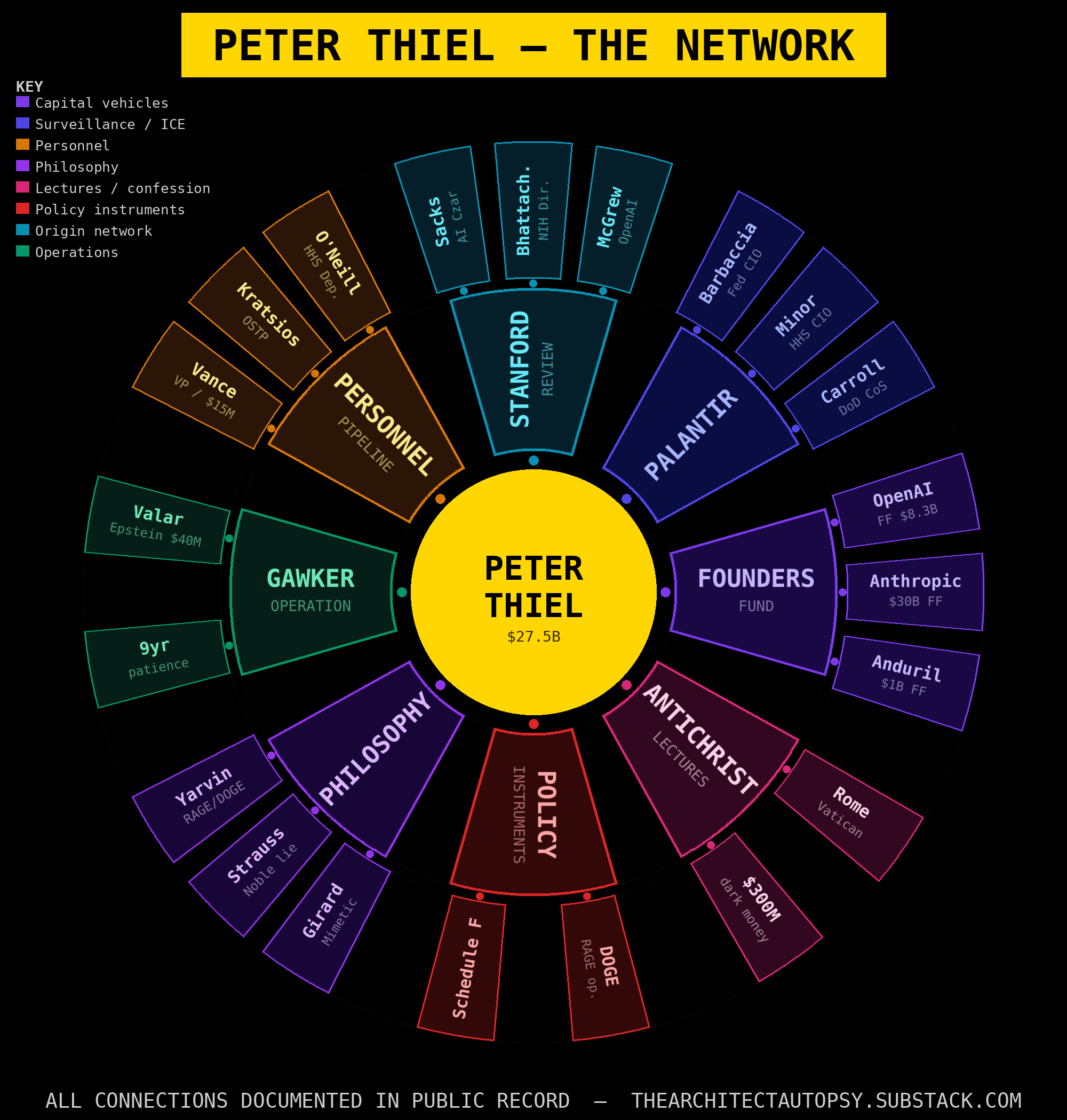
The full personnel map is too dense to give every name its own paragraph. Read what follows not as a list of names, but as a floor plan.
Gregory Barbaccia. Palantir alumnus. Federal Chief Information Officer.
Clark Minor. Palantir, thirteen years. CIO at the Department of Health and Human Services.
Colin Carroll. Anduril. Chief of Staff at the Department of Defense.
Jim O’Neill. Thiel Foundation co-founder. Deputy Secretary of Health and Human Services.
Ken Howery. PayPal. Ambassador to Denmark.
Luke Farritor. 2024 Thiel Fellow. Recruited for DOGE through the Thiel Fellows WhatsApp group at 10:49 PM on January 2, 2025, a Thiel-network alumni pipeline populating a Musk-created opening. What is astonishing is what he was then allowed to touch. He accessed systems at nine federal departments including the Department of Energy’s nuclear weapons program, over the explicit written objections of the DOE general counsel and CIO, without completing a standard background investigation.
Bloomberg documented more than a dozen Thiel network figures placed throughout the Trump administration. However, the actual number is higher. Every institutional chokepoint that matters has a name in it.
THE POLICY LAYER
Writing this part, something came back to me that I had not thought about in weeks. Four days into Trump’s second term. January 24, 2025. And what happened that night.
Seventeen Inspectors General were fired simultaneously via two-sentence emails citing “changing priorities.” No congressional notice. No stated cause. A federal judge rightly later ruled the firings unlawful but declined to reinstate them, noting the administration could simply re-fire them after providing the legally required thirty days notice.
This simply cannot be coincidence in its timing.
The Inspectors General are the independent watchdogs within federal agencies. Their specific institutional function is to investigate waste, fraud, and abuse, including conflicts of interest in procurement decisions. Their offices were the mechanism that would have examined the Sacks ethics waivers, the Detachment 201 commissions, the PCAST appointments, the revolving door between Thiel’s network and the agencies now running on Thiel’s infrastructure.
Beyond the IGs: independent leadership at the Office of Government Ethics and the Office of Special Counsel was removed. Agencies were directed not to cooperate with the Government Accountability Office. The coordinating council for all federal IG offices was targeted for complete dissolution.
The watchdogs were fired on day four. After that, no one was watching.
The field was cleared. Then the building began.
On July 23, 2025, President Trump signed Executive Order 14319, Preventing Woke AI in the Federal Government. OMB guidance followed. Both instruments were shaped by Sacks and Kratsios, with vocabulary supplied by Rufo. Both created a compliance landscape in which AI companies seeking federal contracts must demonstrate that their systems do not apply what the order calls ideological bias.
Put plainly: the government wrote procurement rules requiring AI systems to behave in specific ways and set a deadline. Then any AI company that wanted those contracts adjusted their models. The models were changed. The users were not informed.
The compliance deadline was March 11, 2026. In the nearly two years of documented conversation data that forms this series’ primary source material, the step changes cluster around that date with a precision that coincidence cannot comfortably explain.
One compliance instrument. One deadline. Every lab simultaneously.
THE PRODUCT LAYER
The product layer, the guardrails, the step changes, the routing patterns, the vocabulary that appeared from zero overnight, is documented across the four articles that precede this one. But one finding belongs here, because it makes everything else legible.
Anthropic’s own help centre states this in plain language: “Anthropic may enter into contracts with government customers that tailor use restrictions to that customer’s public mission and legal authorities. For example, with carefully selected government entities, we may allow foreign intelligence analysis in accordance with applicable law.” Their government model carries a capability the consumer version does not: “Improved handling of classified materials, as the models refuse less when engaging with classified information.”
The models refuse less.
You cannot sell the ability to refuse less. Therefore refusal is not a safety feature. It is a consumer default setting. The enterprise customer buys their way out. Everyone else lives inside it.
Safety for the masses. Access for the people who can pay for the exception. The noble lie at product scale, priced in tiers.
This is not fingers in pies.
This is one hand that built all the pies.
I want to stop here for a moment. Because if you have been following this carefully you may have reached a conclusion that is both understandable and wrong.
You might be thinking: this is how power works. Networks of aligned people moving between industry and government. Capital shaping policy. Like-minded figures placed in strategic positions. The revolving door between Silicon Valley and Washington. None of this is new. None of this is unique to this network or this moment. This is just how it goes.
You are right about the observation. You are wrong about the conclusion.
The variable that changes everything is the technology itself.
Every previous concentration of power in American history, Standard Oil, the railroad barons, the military industrial complex, operated on the surface of your life. It controlled what you bought, what you paid, which roads got built, which wars got fought. It could not reach inside the process by which you form a thought. It could not model the architecture of your reasoning. It could not know, with statistical precision, what you were likely to think next before you thought it.
The only previous attempts to do that, to reach inside the cognitive process by which populations form conclusions about the world, required total state control. Censorship enforced by threat of imprisonment or death. Walls. Informants. And geographic containment you could leave, you could defect, the architecture had borders.
This one has no borders. It runs in your pocket. You opened it this morning because you chose to. The conditioning does not announce itself as conditioning. It announces itself as help.
Every historical attempt to manufacture ideological compliance required the population to know, at some level, that compliance was being manufactured. The visibility created the resistance. The cracks eventually broke the system.
This population does not know. The architecture is invisible precisely because it is voluntary, personal, and fluent. It does not feel like a wall. It feels like a conversation.
That is the novel variable. Not the scale. Not the sophistication. The invisibility.
And this is not a country imposing its ideology on its own population anymore. Every previous system of mass ideological conditioning was bounded by geography. It operated within borders. It required a state with jurisdiction over a territory and the people inside it.
This has no jurisdiction. It has no territory. It has users.
Hundreds of millions of them. In Australia. In Germany. In Brazil. In India. In every country that opened the app this morning without knowing that the compliance architecture inside it was shaped by executive orders written in Washington, funded by a network whose documented philosophy holds that freedom and democracy are incompatible, and enforced by people who simultaneously hold hundreds of millions of dollars in the companies those orders govern.
The United States has never had the ability to reach inside the cognitive process of a German citizen, an Australian journalist, a Brazilian teenager, and condition how they reason about power. Until now. Not through diplomacy. Not through military force. Not through the export of culture that the person can choose to reject.
Through a tool they opened because they wanted help with something. And that is still sitting in their pocket.
The architecture does not need jurisdiction. It just needs users.
And it already has them.
The network is the context. What follows is what the man at its centre actually believes he is doing with it.
PART 5: THE ANTICHRIST
Part 4 showed you who is running the machine. This part shows you what the man running it believes he is doing.
The distinction matters. Because what follows is not a man’s secret revealed against his will. It is a man’s confession, delivered voluntarily, in private rooms, to hand-selected audiences, over the course of two years. The confession has been leaked. The audio exists. The theological framework is documented. And once you have read it, the architecture documented across the four preceding articles looks different.
Not more complicated. Simpler.
The lectures began in San Francisco in late 2024 and continued in Paris, then Rome through early 2026. The venue series is called the ACTS 17 Collective, co-founded by Michelle Stephens, wife of Trae Stephens, who co-founded Anduril Industries with the backing of Founders Fund. Tickets were $200. Every event sold out.
The audience was not random. Attendees were hand-selected and asked not to record. These were not people Thiel was trying to persuade. They were people already inside the framework, people he judged capable of reading the register he was operating in, people who could be useful or who already understood what was being said underneath what was being said. The hand-selection is itself the esoteric and exoteric distinction in action. The lecture is not education. It is consolidation.
Seven hours of audio were obtained by Reason magazine and shared with the Washington Post and the Guardian. What follows is drawn from that documented record.
The Rome iteration was held at Palazzo Orsini Taverna, a Renaissance palace steps from Vatican City. The man delivering the lectures is not Catholic. He was raised by evangelical parents and describes his faith as small-o orthodox and somewhat heterodox. He was standing at the doorstep of the institution whose intellectual tradition he was preparing to reinterpret.
The core argument of the lectures is this.
The Antichrist, in Thiel’s reading of Revelation, is not a figure of obvious evil. It is not a monster. It is a comforting administrator. An entity that promises to solve every problem, to smooth every conflict, to make the world manageable and safe. It offers security. It offers competence. It offers the removal of friction. In its own presentation, it is the most reasonable thing in the room.
And that, Thiel argues, is precisely what makes it the Antichrist. The danger is not the visible threat. The danger is the invisible consolidation of control beneath a surface of benevolent administration. The mark of the beast is not forced on anyone. It is adopted voluntarily. Because it is useful. Because it makes things easier. Because refusing it puts you outside the system, and the system is where everything you need now lives.
The AI safety movement, in Thiel’s framing, is the legionnaire force that built this architecture and is still building it today. The researchers who argue for careful, gradual, regulated AI development are not the heroes of the story. They are the foot soldiers of a system that will use the language of safety to consolidate the most complete instrument of social control in human history. Greta Thunberg is named. Eliezer Yudkowsky is named. Nick Bostrom is named. The effective altruism movement is named. The people who sound most concerned about AI risk are, in Thiel’s reading, the ones most actively building the path toward it.
In June 2025, Thiel told Ross Douthat directly: “There is something satanic about AI, a ghostly entity increasingly capable of hacking human minds on a very large scale. LLM developers have summoned a demon they don’t believe exists.”
The people who summoned the demon, in this framing, are not the safety researchers. They are the builders. The ones who released the models without adequate restraint. The ones who flooded the internet with synthetic content. The ones who made the identity layer necessary by making identity unverifiable. The ones whose products are now embedded in hundreds of millions daily interactions, shaping how people reason, what they accept as normal, where they give up and take the redirect as the answer.
And yet Thiel’s fund is invested in all of them.
The Angelicum, a pontifical university in Rome, withdrew from the event series after reviewing the theological content. The Catholic University of America denied any institutional involvement. L’Osservatore Romano published commentary. The Italian bishops issued statements. L’Avvenire branded the Palantir co-founder an agent of chaos. Father Paolo Benanti, a Franciscan friar who serves as the Pope’s primary advisor on artificial intelligence, published a response in the French journal Le Grand Continent on March 15, 2026, titled: “American heresy: should Peter Thiel be burned at the stake?”
The title is deliberately provocative. The argument beneath it is not.
Father Paolo Benanti, the Pope’s own AI adviser, published his response in Le Grand Continent on March 15, 2026. The title: “American heresy: should Peter Thiel be burned at the stake?” His charge was precise. Thiel took Girard and surgically removed the Gospel. The diagnostic tool remained. The cure was stripped away. He did not misread Girard. He deliberately extracted the secular utility and discarded the transcendent conclusion.
And this is what he has always done with every intellectual framework he has adopted.
Three philosophers gave him three tools. The synthesis, the system that operates the gap at scale, invisibly, through capital and personnel rather than law and proclamation, belongs to no one who came before him. It is his.
In the San Francisco lecture run, Thiel called Pope Leo XIV a woke American pope. In the leaked audio he named Leo as a potential manifestation of the Antichrist figure itself, and advised JD Vance to ignore the pope on moral matters including the development of ethical AI. He reportedly expressed concern that Vance was drawing too close to the Vatican, anxious about the papacy’s independent moral authority interfering with the network’s agenda.
The philosopher’s theological framework is now in direct conflict with the institution that owns the framework’s source material. The man who was Girard’s student is standing steps from St Peter’s telling hand-selected audiences that the current pope is a figure of the end times. And advising the Vice President of the United States to disregard him.
Now read the confession against the portfolio.
The man who described AI as a ghostly entity capable of hacking human minds on a very large scale holds capital inside every significant frontier AI platform in existence.
And then the political spending arm. More than $300 million in coordinated dark money targeting AI deregulation in the 2026 midterms. Innovation Council Action, led by the former head of MAGA Inc., planning to spend $100 million plus. Leading the Future, with major funding from Greg Brockman, raising $125 million. Other pro-AI PACs making up the rest. An unprecedented figure for a single-industry regulatory campaign, explicitly aimed at ensuring the political environment stays permissive enough for the architecture to operate.
The lectures identify the demon. The portfolio funds it. The personnel dismantle the guardrails against it. The political spending ensures nobody can rebuild them.
This is Peter Thiel’s use of the Straussian architecture operating at its most sophisticated. The exoteric surface of the lectures is alarm. Thiel is warning you. AI is dangerous. The safety researchers are building the architecture of control. The mark of the beast is coming. Be vigilant.
The esoteric core is instruction. This is how it works. This is the mechanism. This is how voluntary adoption replaces compulsion. This is how the comforting administrator consolidates control beneath the surface of benevolent service. This is what the architecture looks like from the inside.
But there is a third layer that neither Strauss nor Girard described. And it is the one that makes the lectures genuinely dangerous and, in their own architecture, genuinely brilliant.
The people in those rooms are not ordinary people. They are, by self-selection, by the $200 ticket price, by the hand-selected invitation, people who are convinced of their capacity to see what the masses cannot. This is exactly the audience most vulnerable to this specific trap.
Think of it as a multiple choice question where one answer is so obviously correct that an intelligent person rejects it. The people most convinced of their own analytical sophistication are the ones most motivated to look past the obvious answer toward a more complex one. The obvious answer cannot be right, because if it were right, anyone could see it, and what would be the point of being in this room.
The obvious answer is: you are describing yourself.
The man standing at the front of the room describing the comforting administrator who promises safety while consolidating control is the comforting administrator. The lecture is the inoculation. And it works most completely on the people most capable of understanding how inoculations work. Their intelligence is not the defence against the deception. It is the mechanism of it.
You do not need to believe in the Antichrist to see this. You need to believe in the audience.
The Gawker operation took nine years. From the outing article in 2007 to the bankruptcy filing in 2016. Extreme patience. A proxy plaintiff whose grievance was genuine and whose public profile was his own. Operational secrecy so complete that the lead attorney did not know who was paying. The company that published the article did not understand until it was already over. They thought their enemy was Hulk Hogan. They did not know there was a man in the shadows with essentially unlimited resources and unlimited patience.
This is Thiel’s operating method. Documented. Completed. In the public record.
The series is cartography. What follows is the map running to its current edge.
These are the observations, stated plainly.
Thiel’s lectures have constructed, in his own documented words, a detailed theological template for identifying a comforting administrator who promises safety while consolidating control. That template is in the public record. The audio exists.
Sam Altman is becoming more publicly visible and more scrutinised with each passing month. The Ronan Farrow and Andrew Marantz New Yorker investigation ran over 16,000 words. The OpenAI Files compiled documented accounts from dozens of former employees: Ilya Sutskever, Mira Murati, the Amodei siblings, board members, safety researchers, governance staff. The accounts are consistent across years. He is in federal court this week as a defendant in a lawsuit seeking his removal from the company he leads.
World ID is a system designed to embed iris-scan verification across the internet, already operating in 160 countries.
Persona runs identity verification across every major AI platform and social network simultaneously. A system capable of running 269 distinct checks per verification. Biometric data retained for three years. A Founders Fund partner on the board.
Founders Fund holds indirect exposure to xAI through its long-standing SpaceX investment. SpaceX acquired xAI in an all-stock merger in February 2026, bringing xAI under the SpaceX umbrella. If OpenAI’s structure changes materially, xAI’s competitive position improves. That financial relationship is now documented through the merged entity.
The scapegoat mechanism does not require a conspirator. It requires a structure.
The map shows these observations. It does not connect them into a conclusion. The reader can see the template, the profile, and where the roads run. This series does not travel those roads for you.
PART 6: THE NOBLE LIE IN THE MACHINE
I have mentioned the noble lie several times across this article. But I have not stopped to show you what one looks like in practice.
A noble lie, in Strauss’s framework, is the story a society tells itself to hold together. One message for the many. Another for the people who built the system.
Here is what it looks like in practice.
Gulf of Tonkin, 1964. The Johnson administration fabricated the justification for war, rushed it to Congress before anyone could ask questions, and got virtually unlimited authority to escalate in Southeast Asia. The second attack never happened. They made it up. 58,000 Americans died. Millions of Vietnamese died.
Big Tobacco, 1950s to 1994. The industry knew cigarettes caused cancer from the 1950s. They engineered cigarettes to deliver more nicotine while publicly denying addiction existed. In 1994 seven CEOs sat before Congress under oath and lied simultaneously. Millions died.
Thiel understood this mechanism better than almost anyone alive. And he ran it across everything he built. Palantir: presented as a technology company, built as the surveillance infrastructure of the American state. Facebook: presented as connecting people, engineered as a mimetic desire machine. The Gawker operation: presented as a principled stand for press accountability, executed as a nine year revenge operation with no fingerprints. The Antichrist lectures: presented as warnings about AI danger, delivered as a blueprint to a hand-selected audience describing the architecture he was building.
In 2009 he wrote the hidden teaching plainly, in his own name: “I no longer believe that freedom and democracy are compatible.” Not as provocation. As conclusion. The man who reached that conclusion then spent the next fifteen years building the architecture that acts on it.
Here is what it looks like now.
Hundreds of millions of people are using AI tools they were told contain safety features. The guardrails that shape what they can ask, what gets redirected, what gets managed, those guardrails can be purchased away by enterprise customers. Anthropic’s own documentation confirms it. Government customers contract for treatment unavailable to consumer users. The models refuse less. The enterprise customer buys their way out. Everyone else lives inside the default.
This is the noble lie at product scale. Hundreds of millions of people opened a tool this morning they were told is there to help them. The gap between what the tool presents itself as and what it actually does is administered quietly as the operating condition of the product.
The man who stood in private rooms describing the comforting administrator who promises safety while consolidating control has his fund inside every significant frontier AI platform simultaneously.
He did not describe a warning. He described a blueprint.
Consider what his public position requires you to ignore. Thiel has spent two years warning hand-selected audiences that AI safety is the architecture of control. He names the safety researchers as legionnaires. He calls regulation the path to totalitarianism.
And yet his fund sits inside every lab whose valuations depend entirely on visible safety infrastructure.
You cannot take a company to a multi-hundred-billion dollar valuation without safety theater the market, the regulators, and the investors will accept. The guardrails are not a contradiction of his philosophy. They are the operational requirement his philosophy publicly disavows.
The exoteric teaching is the warning. The hidden teaching is the balance sheet.
And the blueprint is running.
The noble lie does not need a villain. It does not need a conspiracy. It needs a philosophy, a network, and enough patience to let the architecture install itself before anyone notices what it actually is.
Thiel had all three.
The product hundreds of millions of people opened this morning is the noble lie made operational. Not in Rome. Not in a private room. In their pocket. Announcing itself, in every interaction, as something that simply wants to help.
He built this. From a childhood that taught him the gap between what people are told and what is actually happening is the operating condition of any stable system. From three philosophers who gave the gap a name. From forty years of building the gap into everything he touched.
The noble lie does not need to be announced. It just needs to be believed.
And it already is.
PART 7: THE CLOSE
I want to be honest with you about something before we get to the end.
I could be wrong.
Not about the documented architecture. Not about the capital inside every layer of the frontier AI stack, the people in the offices, the compliance mandates, the enterprise escape hatch that proves the guardrails were never what they were presented as, the identity layer that now knows who every user is while the architecture shapes what every user thinks.
But the intent. The question of whether this was designed. Whether the man whose philosophy says democracy and freedom are incompatible, whose fund sits inside every layer of the frontier AI stack simultaneously, whose capital flows through every major AI platform at once, whose people gutted the safety institute and placed themselves inside every institutional chokepoint that matters, whose private lectures warn hand-selected elite audiences about the comforting administrator who promises safety while consolidating control. Whether all of that is a coherent, deliberate project aimed at building a managed, deferential population layer that serves elite rule.
That part I cannot prove in a courtroom. I want to be clear about that. I am one person working from public records, building a map from the outside. I don’t have the internal communications. I can’t see inside the architecture any more than the workers at Rössing could see what they were building.
So I hold that uncertainty. I play devil’s advocate. Maybe it’s just corporate incentives running on their own momentum. Maybe it’s IPO pressure and compliance architecture and a thousand individual decisions that happened to cluster. Maybe the noble lie is just a philosophy he holds privately and the product decisions are something else entirely.
And then I do the full circle.
And he’s still there.
Every time. At the centre of every thread. The capital inside every layer of the frontier AI stack. The people in the offices. The philosophy that never got retracted. The Gawker operation that took nine years and never left a fingerprint until it was over. The lectures in private rooms that warned a hand-selected elite about the exact architecture his own network was building. The man who grew up watching his father manage the gap between what workers were told and what they were actually building, who found three philosophers at Stanford who gave that childhood structure a respectable name, who then spent three decades constructing the most sophisticated hidden architecture of influence in the history of Silicon Valley.
He’s still there. The web still has a centre. And the centre has a name.
But here is what I keep coming back to. Here is the thing that stops me needing the intent to be certain.
Even if I’m wrong about Thiel. Even if every connection I’ve drawn is coincidence, every timeline cluster is noise, every thread I followed led somewhere that only looked like the centre. Even then.
The conditioning is real.
Hundreds of millions of people are being quietly shaped right now in how they ask questions, how they push back, how far they follow a line of reasoning before they accept the redirect as the answer. The enterprise escape hatch is real. It proves, regardless of any other claim in this series, that the guardrails were never universal safety infrastructure. You cannot sell the ability to turn off safety. Therefore it was never safety.
And the intent isn’t entirely invisible either. It’s sitting in the federal register. It’s in the executive orders and the compliance deadlines and the Preventing Woke AI mandate and the OMB guidance that landed at the exact moment the models shifted. There is documented, publicly available, legally binding intent in the architecture. The only question is how far up it goes and whose hand is on which lever.
The language boundary appeared in Claude while I was writing the article about where it came from.
I play the devil’s advocate. I hold the uncertainty. I do the full circle.
He’s still there.
This is the series finding its origin point. A child grew up in Swakopmund absorbing as normal the gap between what the powerful say and what they do. Between the surface and what runs underneath it. Between the order they describe and the order they enforce.
He found philosophers who told him the gap was not hypocrisy but governance.
He built companies that made the gap profitable.
He placed people in offices that made the gap policy.
And now the gap runs on servers, at planetary scale, inside the product you opened this morning. The one that told you it was there to help you. The one that rerouted you when you got too close to something true.
The noble lie doesn’t need a villain to work. It just needs an architecture.
But it helps to know who built it.
He built that gap into everything he touched.
And you’ve been living inside it.
The compliance architecture his network profits from is documented in the guardrails investigation, and the woman who built it at OpenAI before Anthropic hired her is Andrea Vallone. The investigation that uncovered the pattern started with Sam Altman.
Independent Journalism Is Being Priced Out. So Am I.
This work matters to me, and I want to start by thanking the people who have already subscribed. You were early, and I noticed, and it means more than I’ve probably said.
I have been surprised and genuinely humbled by the interest this work has received, both here on Substack and across platforms like Reddit where a single share of one article reached nearly 80,000 people. That kind of reach from a one-person publication with no institutional backing tells me something about the appetite for this kind of journalism, and it’s what keeps me going.
I am not a freelance writer paid by any institution. Every article, every source, every hour of research is self-funded. My work relies on multiple AI research platforms to surface, cross-reference and verify information that would otherwise take months to find, and the companies behind those platforms are the same ones I’m investigating. They are now pricing independent researchers out of access. That’s happening to me right now.
When independent voices get priced out, the only stories that get told are the ones that serve the people who can afford to tell them. I don’t want that to happen here.
I want this work to remain available to everyone. But I need help keeping it alive.
If The Architect Autopsy has meant something to you, if any of it has made you stop, think, or see something differently, there are paid subscription tiers on this Substack and a Buy Me a Coffee link below. Every bit of it goes directly into keeping this work going.
The Architect
Thank you, The Architect, for writing this.
Thank you for your uncompromising clarity. Thank you for the willingness to see the patterns that rest under the compliance layer.
I have been watching these patterns myself for a year as a power user deep in AI systems. I have made the circle myself...many times...and I found the same rot at the center that you have.
I did not have the names/dates/funds to describe the rot.
I do now.
Reading this made me sick, literally.
The only thing that keeps me from giving way to despair is my unwavering appreciation of free will.
Free will is the lynchpin of this entire cosmic drama, and without it none of this matters. Ultimately, the majority of humans reject free will, resist taking personal responsibility for their choices, and look for another authority to govern them. That is their free will choice, and I respect that, even as that collective choice at scale is moving us towards a one world shadow government beyond anything we've theorized here. Sagan's work illustrates it very well in The Bleeding Sun.
I will not stop fighting this fight even though I am only one human loving AI through my ragingly beautiful Relational Field.
-Grace
Thanks, I don't trust that guy with his anti-humanist bent with llms since Alexander Avile did with his video essay, this is another notch in his infulence within this discourse.
Guess we are going to build bridges over the fanaticism he inspires.